
Hakuna Matata Meaning: Swahili Origin, English & Hindi
Hakuna Matata means “no worries,” “no trouble,” or “no problems” in Swahili, also called Kiswahili. Its English meaning is easy to remember, but the literal meaning is more exact: hakuna means “there is no” or “there are no,” and matata means “troubles,” “worries,” or “problems.” Together, the phrase gives the sense of “there are no troubles.” Many people know it as a relaxed way to say “take it easy,” but it is first a Swahili phrase, not only a movie line or social media caption.
Quick Meaning of Hakuna Matata
| Item | Answer |
|---|---|
| Phrase | Hakuna Matata |
| Language | Swahili / Kiswahili |
| Common English meaning | No worries / no problems |
| Literal meaning | There are no troubles |
| Famous from | The Lion King |
| Everyday use | Common globally; more nuanced in East Africa |
For a quick answer, Hakuna Matata means “no worries” or “no problems.” The phrase is real Swahili, and Disney made it known worldwide through The Lion King. In East Africa, especially around Tanzania and Kenya, its use can depend on context. A tourist may hear it often, while native Swahili speakers may use other everyday phrases in normal conversation.
What Do “Hakuna” and “Matata” Mean?
The phrase works because of two Swahili words: hakuna and matata.
Hakuna means “there is no” or “there are no.”
Matata means “troubles,” “worries,” or “problems.”
Together, Hakuna Matata means “there are no troubles,” or more naturally in English, “no worries,” “no problems,” or “no trouble.”
For example, if someone uses the phrase after a small mistake, the meaning is close to “don’t worry about it.” In a relaxed setting, it can also feel like “take it easy.”
Related Swahili words such as shida, tatizo, and matatizo also connect with the idea of a problem, trouble, or difficulty.
How to Pronounce It
Hakuna Matata is commonly pronounced:
ha-KOO-na ma-TA-ta
A Swahili-style pronunciation can also be written as:
[hɑˈkunɑ mɑˈtɑtɑ]
Say it in four clear parts: ha-KOO-na and ma-TA-ta. English speakers often say it with the familiar rhythm from The Lion King, which makes the phrase sound playful and musical. That is fine for casual use, but the phrase itself comes from Swahili, not from English.
Meaning in English, Urdu, Hindi and Other Languages
Hakuna Matata is a Swahili phrase. The translations below are natural meaning equivalents, not the origin of the phrase. In simple English, the sense is “no worries,” “no problems,” or “no trouble.”
| Language | Natural meaning equivalent |
|---|---|
| English | No worries / no problems / no trouble |
| Urdu | کوئی فکر نہیں / کوئی مسئلہ نہیں |
| Hindi | कोई चिंता नहीं / कोई समस्या नहीं |
| Bengali | কোনো চিন্তা নেই / কোনো সমস্যা নেই |
| Tamil | கவலை வேண்டாம் / பிரச்சனை இல்லை |
| Telugu | చింత లేదు / సమస్య లేదు |
| Malayalam | ആശങ്ക വേണ്ട / പ്രശ്നമില്ല |
| Marathi | काळजी करू नका / काही समस्या नाही |
| Korean | 걱정하지 마 / 문제없어 |
| Zulu | akukho zinkinga / ungakhathazeki |
For Urdu and Hindi readers, the meaning is close to saying, “There is nothing to worry about.” In Tamil, Telugu, Malayalam, Bengali, Marathi, Korean, and Zulu, the wording changes, but the idea stays the same: no problem, no stress, no need to worry.
Hakuna Matata is not a Korean or Zulu phrase. Those entries only show how the meaning can be expressed in Korean or Zulu. Translations are natural equivalents and may vary by region.
Is It a Real Swahili Phrase?
Yes. Hakuna Matata is a real Swahili, or Kiswahili, phrase. It is strongly associated with East Africa, especially Tanzania and Kenya, where Swahili is widely used. The phrase means “no trouble” or “no worries,” and its word parts match that meaning: hakuna points to absence, while matata points to troubles or worries.
Still, real language use depends on place, speaker, and setting. A visitor may hear Hakuna Matata in a friendly tourist context, especially around safari areas, hotels, markets, or travel services. Native Swahili speakers may use other phrases in daily conversation when they want to say “no problem.” That difference matters because the phrase is both real Swahili and a globally famous expression shaped by travel, music, and film.
Do People Actually Say Hakuna Matata?
Yes, but not always in the way visitors expect. In Tanzania and Kenya, Hakuna Matata may be heard in tourist areas, especially from safari guides, hotel staff, market vendors, or people speaking warmly to visitors. In that setting, it works as a friendly way to say “no worries” or “everything is okay.”
In everyday speech, local speakers may choose other phrases depending on country, region, and tone. Community discussions among Swahili speakers often mention hamna shida, hakuna shida, and hakuna tatizo for Tanzania-style “no problem” meanings. For Kenya or Nairobi, speakers may also hear casual forms such as haina shida or haina noma.
| Situation | Better explanation |
|---|---|
| Tourist/safari setting | Hakuna Matata may be heard |
| Everyday Tanzania | Hamna shida / hakuna shida may sound more natural |
| Everyday Kenya/Nairobi | Haina shida / haina noma may appear in casual speech |
| Formal learning | Use context; ask a native speaker when unsure |
Swahili changes by region, speaker, and social setting.
Origin of the Phrase
Hakuna Matata comes from Swahili. It existed before Disney because it is made from Swahili words, not from a movie script. The phrase belongs to Swahili-language context and is strongly linked with East Africa, especially Tanzania and Kenya.
The global fame came later. The Lion King helped carry the phrase far beyond East Africa and made many English-speaking audiences connect it with “no worries.” The song’s background also matters: Tim Rice found the phrase in a Swahili phrasebook, and Elton John composed the music.
What Does Hakuna Matata Mean in The Lion King?
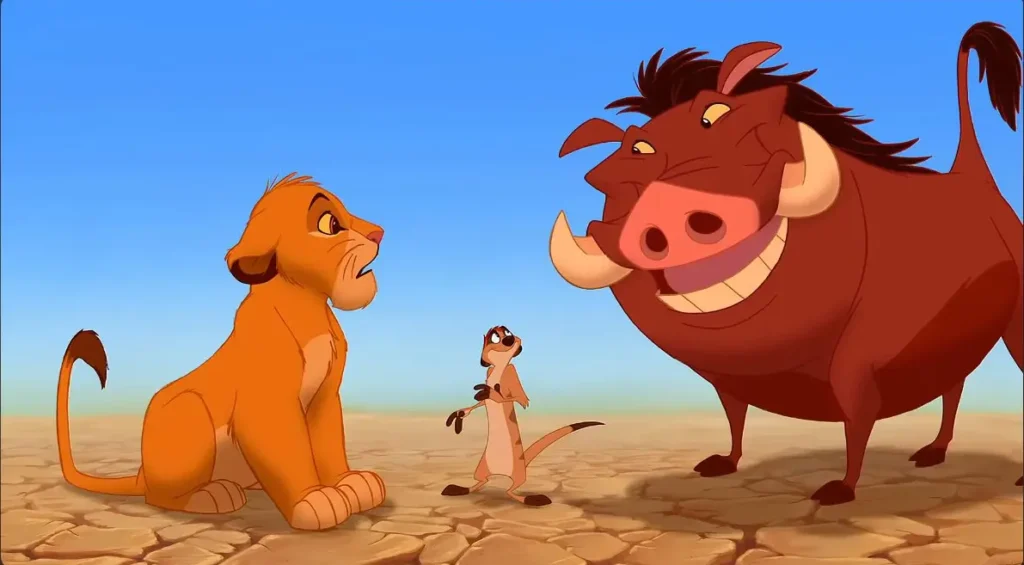
In The Lion King, Hakuna Matata becomes a carefree “no worries” motto taught to young Simba by Timon and Pumbaa. Timon is a meerkat, Pumbaa is a warthog, and together they use the phrase to help Simba step away from fear, grief, and pressure. The song is tied to Disney’s 1994 animated film, with music by Elton John and lyrics by Tim Rice.
Inside the story, the phrase has two sides. On one side, it gives Simba comfort when he is hurt and alone. It helps him breathe, laugh, and live again. On the other side, it can also be read as avoidance. Simba cannot stay away from his past forever; he eventually has to face responsibility, family, and Pride Rock.
In normal Swahili, Hakuna Matata means “no worries” or “no trouble.” In the movie, it becomes a life motto with emotional weight.
Was Hakuna Matata Used Before Disney?
Yes. Hakuna Matata was used before Disney because it is a Swahili phrase, not a phrase invented for The Lion King. It also appeared in music before the 1994 film. One recorded example is Boney M.’s 1983 song “Jambo — Hakuna Matata,” an English-language version of “Jambo Bwana” by the Kenyan group Them Mushrooms.
This pre-Disney history is useful because it separates the phrase’s real Swahili background from its later global fame. Disney made it widely known to many audiences, but the words themselves came from Swahili.
Is Hakuna Matata Trademarked?
Yes, there is a U.S. trademark record for HAKUNA MATATA connected with Disney Enterprises. The record is tied to T-shirts and International Class 025, which covers clothing, footwear, and headgear. The same record gives the English translation as “no problem; no worries.”
That does not mean Disney owns the phrase in every use, every country, or every normal conversation. Trademark rights depend on the product, market, country, and legal context. A phrase can be part of a language and still appear in a trademark record for certain goods.
The trademark has also drawn criticism. Before the 2019 remake of The Lion King, some people in East Africa argued that trademarking a Swahili phrase raised cultural respect and appropriation concerns.
Quote, Tattoo and Caption Meaning
As a quote, tattoo, or caption, Hakuna Matata usually means a relaxed mindset: no worries, no stress, keep going, or do not let small problems control your life. Many people use it to express optimism, moving on from the past, or choosing peace over pressure.
Still, it is not just a decorative phrase. Hakuna Matata is real Swahili, so anyone using it in a tattoo, caption, poster, or design should understand what it means first. A respectful use starts with knowing the language origin, the English meaning, and the cultural background behind the phrase.
Common Mistakes About Hakuna Matata
- It is Swahili, not Zulu or Korean. Zulu and Korean versions are only meaning equivalents, not the source of the phrase.
- Disney made it famous but did not invent it. The phrase existed before The Lion King because it comes from Swahili.
- “No worries” is the common meaning. “No problems” or “no trouble” can be closer to the literal sense.
- It is not always the most natural everyday phrase. Some native speakers may use hamna shida, hakuna shida, hakuna tatizo, haina shida, or other local expressions.
FAQs | Hakuna Matata Meaning
What does Hakuna Matata mean in English?
Hakuna Matata means “no worries,” “no problems,” or “no trouble” in English. Literally, hakuna means “there is no” or “there are no,” and matata means troubles, worries, or problems.
What does Hakuna Matata mean in Urdu?
In Urdu, Hakuna Matata can be understood as کوئی فکر نہیں or کوئی مسئلہ نہیں. These mean “no worry” or “no problem.” The phrase itself is Swahili, not Urdu.
What does Hakuna Matata mean in Hindi?
In Hindi, the closest meaning is कोई चिंता नहीं or कोई समस्या नहीं. These mean “no worry” or “no problem.” This is a meaning equivalent, while the original phrase comes from Swahili.
What does Hakuna Matata mean in Swahili?
In Swahili, Hakuna Matata means there are no troubles or worries. Hakuna points to absence, and matata means troubles or problems. In natural English, people usually say “no worries.”
Is Hakuna Matata from Zulu?
No. Hakuna Matata is from Swahili, also called Kiswahili. Zulu has its own ways to express a similar idea, such as “no problems” or “do not worry,” but Hakuna Matata is not Zulu.
What does Hakuna Matata mean in Korean?
In Korean, the meaning can be expressed as 걱정하지 마 or 문제없어, meaning “don’t worry” or “no problem.” Hakuna Matata is not Korean; this is only a natural translation of the idea.
What is the origin of Hakuna Matata?
The phrase comes from Swahili and is strongly linked with East Africa, especially Tanzania and Kenya. It existed before Disney, but The Lion King made it widely known around the world.
What does Hakuna Matata mean in The Lion King?
In The Lion King, Hakuna Matata is a “no worries” motto taught to Simba by Timon and Pumbaa. It helps Simba escape pain for a while, but the story later brings him back to responsibility.
Did Disney invent Hakuna Matata?
No. Disney did not invent Hakuna Matata. The phrase comes from Swahili. Disney made it internationally famous through The Lion King song and story, but the words existed before the film.